RevOps in 2026: The Trends Reshaping Sales Operations
Revenue operations is evolving fast. Here are the trends every RevOps leader needs to understand and act on.
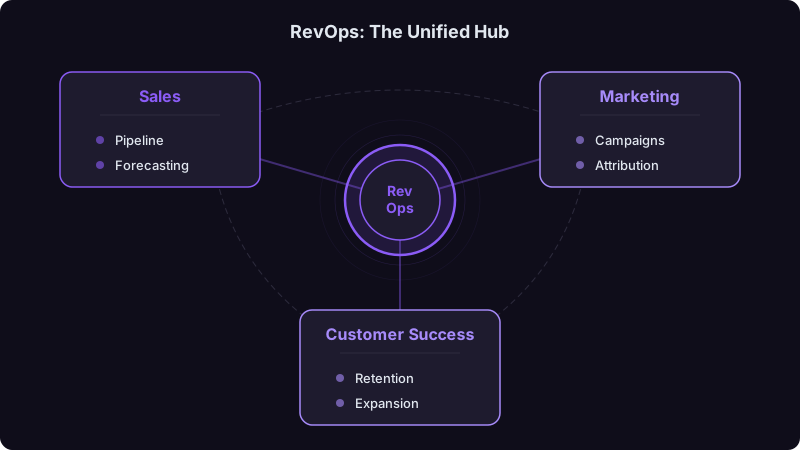
I've spent the last three years building RevOps functions at two B2B SaaS companies, one mid-market and one enterprise. In that time, I've watched revenue operations go from a "nice to have org chart experiment" to the single most important function determining whether a go-to-market team wins or loses. What I'm seeing in 2026 is a set of shifts that are fundamentally changing how RevOps teams operate, what they're measured on, and where they spend their time.
This isn't a list of buzzwords. These are the trends I'm seeing in my own work, in conversations with other RevOps leaders, and in the data we're tracking across our customer base.
The State of RevOps in 2026
Before we get into the trends, here's where things stand. When I started in RevOps in 2021, most companies didn't even have the title on their org chart. Now it's everywhere, and the data backs it up.
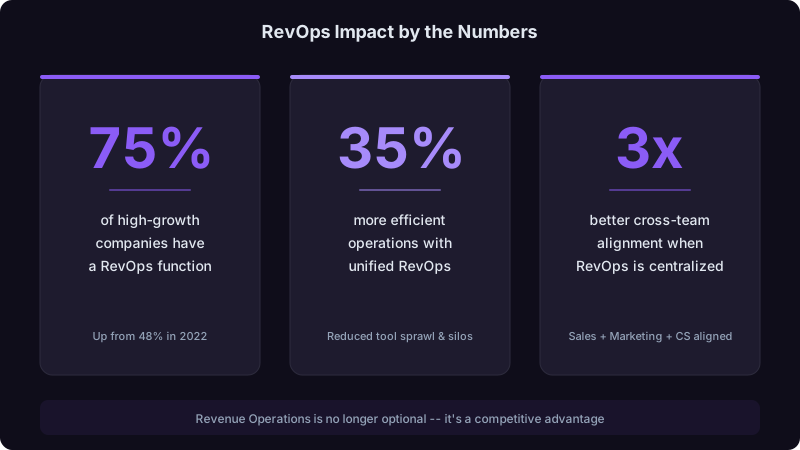
- 75% of high-growth companies now have dedicated RevOps functions
- RevOps teams have grown 35% year-over-year
- Companies with mature RevOps grow revenue 19% faster
But here's the thing: having a RevOps team and having a *mature* RevOps function are very different things. Most companies I talk to are still in the early stages, doing reactive work like fixing broken Salesforce workflows and building reports when someone asks for them. The trends I'm going to cover are what separates the teams that are just "keeping the lights on" from the ones that are genuinely driving revenue strategy.
RevOps Maturity: Where Most Teams Actually Are
Before we get into trends, it's worth being honest about where most teams sit. I built this maturity framework after auditing RevOps functions at about 40 companies over the past two years:
| Maturity Stage | Characteristics | % of Companies (est.) | Typical Team Size |
|---|---|---|---|
| Stage 1: Reactive | Fixing broken workflows, ad hoc reporting, no data governance | 35% | 1-2 people |
| Stage 2: Organized | Defined processes, regular reporting cadence, basic automation | 30% | 3-5 people |
| Stage 3: Strategic | Cross-functional alignment, predictive models, owned KPIs | 25% | 5-8 people |
| Stage 4: Transformative | AI-first operations, revenue architecture, board-level influence | 10% | 8-15 people |
Most of the trends I'm covering here are what Stage 3 and Stage 4 teams are doing right now, and what Stage 1 and 2 teams should be planning for over the next 12 to 18 months.
Trend 1: AI-First Operations
This is the biggest shift I'm seeing, and I want to be specific about what "AI-first" actually means in practice because the phrase gets thrown around loosely.
At my last company, we had two full-time people whose primary job was data hygiene. They spent 30+ hours per week enriching lead records, deduplicating contacts, standardizing company names, and fixing broken field mappings. That work was necessary but it was a terrible use of human judgment.
Today, AI handles most of that automatically. Here's what we've moved to AI in the past year:
- CRM data enrichment and cleaning: Tools like Clay and Clearbit now auto-populate and correct 85% of the fields we used to maintain manually. Our data accuracy went from roughly 72% to 94% in six months.
- Intelligent lead routing: Instead of round-robin or territory-based assignment, we route leads based on fit scoring, rep capacity, and historical win rates by segment. Our speed-to-lead dropped from 4.2 hours to 11 minutes.
- Automated forecasting: Our forecast accuracy improved by 23 percentage points when we switched from manager roll-ups to an AI model trained on our own historical data. The model catches pipeline inflation that humans consistently miss.
What This Actually Changes
The role of RevOps is shifting from "data janitor" to "strategic analyst." The two people who used to spend their weeks on data hygiene now spend their time building propensity models and identifying expansion signals. That's a massive upgrade in the value the team delivers.
But there's a catch. AI-first operations require clean data infrastructure to work. If your CRM is a mess, AI tools will just automate your bad data faster. We spent three months on a data cleanup project before any of the AI tooling was useful. Don't skip that step.
Trend 2: Tool Consolidation
The average B2B sales tech stack hit a peak of about 13 tools in 2023. I know because I was the one managing the renewals. Every tool had its own login, its own data model, its own integration requirements, and its own renewal negotiation. It was expensive and it created data silos everywhere.
In 2026, I'm seeing aggressive consolidation happening for three reasons:
Cost pressure is real. When budgets tightened in 2023-2024, CFOs started asking hard questions about $200K+ annual software spend for sales tools. At one company, we cut from 11 tools to 6 and saved $140K per year without losing any critical capability.
Integration debt compounds. Every point-to-point integration is a potential failure point. We had a Marketo-to-Salesforce sync that broke silently for three weeks and resulted in 400+ leads that never got routed. Nobody noticed because the tool that was supposed to alert us about sync failures had its own integration issue.
All-in-one platforms have gotten genuinely good. Two years ago, the "all-in-one" pitch was aspirational. Now platforms like HubSpot, Salesforce Revenue Cloud, and newer entrants are actually delivering on multi-function capabilities that used to require three or four separate tools.
What This Actually Changes
Fewer tools means less context switching for reps, fewer data reconciliation headaches for RevOps, and lower total cost of ownership. But it also means higher stakes for each platform decision. When you consolidate from 12 tools to 5, each of those 5 tools is now mission-critical. You need to be more rigorous about evaluation, more demanding during trials, and more strategic about migration planning.
My recommendation: build a tool rationalization scorecard. For every tool, assess whether it's a "core platform" (must own, deeply integrated), a "best-of-breed specialist" (does one thing better than any platform), or a "candidate for replacement." Be ruthless about that third category.
Trend 3: Revenue Attribution That Actually Works
I've been in marketing-sales alignment meetings where the two sides literally couldn't agree on the numbers because they were pulling from different systems with different attribution logic. Marketing would say "we sourced 40% of pipeline" and sales would say "marketing sourced 15%." Both were technically correct given their respective models. Both were also useless.
Multi-touch attribution is finally becoming the standard, and it's changing these conversations:
- First-touch and last-touch are dying. They were always misleading. A deal that started with a webinar attendance, went through 6 months of content engagement, got a cold outbound touch, had a referral from a customer, and then came inbound through a demo request shouldn't be credited entirely to any single channel.
- Revenue impact is tracked across the full funnel. This means marketing doesn't just own "MQL generation" and sales doesn't just own "close." Both teams see how their efforts contribute at every stage.
- Unified dashboards eliminate the "whose numbers are right" debate. When everyone looks at the same data with the same model, meetings get a lot more productive. We went from 60-minute attribution debates to 10-minute reviews.
What This Actually Changes
When attribution is shared and transparent, it changes behavior. Marketing stops optimizing for MQL volume and starts optimizing for pipeline quality. Sales stops dismissing marketing-sourced leads and starts engaging with them faster. The finger-pointing decreases and the collaboration increases. At our company, shared attribution led to a 31% improvement in marketing-sourced deal velocity because sales reps finally trusted the leads enough to prioritize them.
Trend 4: Predictive Operations Replace Reactive Firefighting
This is the trend I'm personally most excited about. For years, RevOps was a reactive function. Something breaks, we fix it. A rep needs a report, we build it. A deal goes dark, we investigate. That model doesn't scale.
Predictive operations means intervening *before* the problem happens. Here are three specific examples from my own work:
Churn prediction: We built a simple model that looks at product usage trends, support ticket frequency, NPS responses, and engagement with customer success outreach. When the model flags an account as "high risk" (which it does about 45 days before typical churn signals become obvious to humans), our CS team reaches out proactively. We've reduced churn by 18% in the accounts where we intervene early.
Pipeline risk scoring: Instead of waiting for a deal to miss its close date, we flag deals where the buying signals have stalled. No new stakeholders added, no document activity, decreasing email engagement. Our sales managers now spend their coaching time on deals that need attention, not just the biggest ones.
Expansion opportunity identification: We score existing accounts based on product usage patterns that historically precede upsell. When an account starts behaving like other accounts that expanded, the account executive gets an alert with specific talking points. This generated $2.1M in expansion pipeline last quarter that we would have missed otherwise.
What This Actually Changes
The RevOps team becomes a genuine strategic partner rather than an operational support function. When you can tell a CRO "here are the 15 deals most likely to slip this quarter and here's why," that changes the conversation from "can you pull me a report?" to "what does the data say we should do?"
Trend 5: Customer-Centric Metrics Replace Activity Metrics
This might be the most important shift of all, and it's the one that's hardest to implement because it requires changing how people are compensated and evaluated.
Traditional B2B metrics, MQLs, SQLs, meetings booked, calls made, are all activity metrics. They measure what your team *does*. Customer-centric metrics measure the *outcome* for the customer:
- Customer lifetime value (CLV): What is a customer actually worth over their entire relationship with you? This forces you to think about retention and expansion, not just acquisition.
- Net revenue retention (NRR): Are your existing customers spending more with you over time? An NRR above 110% means your customer base is growing even without new logos. We went from 97% to 114% after shifting to customer-centric metrics and restructuring our CS team around them.
- Time to value (TTV): How quickly does a customer realize the benefit they bought your product for? We found that customers who hit their first value milestone within 14 days had 3x higher NRR than those who took 45+ days.
- Customer effort score (CES): How hard is it to do business with you? This covers everything from onboarding friction to billing complexity to support responsiveness.
The shift from activity metrics to customer-centric metrics represents the biggest mindset change in RevOps. Teams that align around customer lifetime value and net revenue retention consistently outperform those still optimizing for MQLs.
What This Actually Changes
When your RevOps function is built around customer outcomes instead of sales activities, everything downstream shifts. Compensation plans reward retention and expansion, not just new bookings. Marketing optimizes for ICP fit (customers who stick) rather than lead volume. Product teams get pulled into revenue conversations because usage data becomes a leading indicator of revenue health.
The hardest part is getting leadership buy-in for the transition period. When you switch from tracking MQLs to tracking CLV, there's a 2-3 quarter window where the old metrics look worse (because you stopped optimizing for them) and the new metrics haven't fully materialized yet. You need executive air cover during that period.
What RevOps Leaders Should Do Right Now
I'll be direct about where I think teams should focus their energy, in priority order:
- 1Audit your tech stack ruthlessly. Map every tool to a capability, calculate real total cost (licenses + integration maintenance + training time), and identify consolidation opportunities. Most teams can cut 30-40% of their tool spend without losing capability.
- 1Invest in AI for data operations first. Don't try to boil the ocean. Start with data enrichment and hygiene, then move to lead routing, then forecasting. Each step builds on the foundation of the previous one. Budget $30-50K for year one if you're mid-market.
- 1Build a single source of truth. If marketing, sales, and CS are looking at different dashboards with different numbers, nothing else matters. Unify your data model before you try to build attribution or predictive models on top of it. This is boring, foundational work and it's the most important thing you can do.
- 1Start with one predictive use case. Pick the one that's easiest to prove: churn prediction, pipeline risk scoring, or expansion identification. Build it, prove the ROI, and use that win to fund the next one.
- 1Align on customer metrics as a leadership team. This isn't a RevOps decision; it's a company strategy decision. RevOps can provide the data and framework, but the CEO and CRO need to own the transition. Start the conversation now even if the full rollout is 6-12 months away.
The companies that get this right, that move from reactive operations to predictive, customer-centric revenue architecture, will outperform their peers by a significant margin. The ones that keep running RevOps as a "Salesforce admin team" will fall behind. The gap between mature and immature RevOps functions is getting wider every quarter, and it's showing up directly in revenue growth rates.
The trends I've outlined aren't predictions. They're already happening at the companies that are ahead of the curve. The question isn't whether these shifts will come to your organization. It's whether you'll be the one leading them or reacting to them.
Ready to transform your sales pipeline?
See how Prospectory's AI-powered platform can help your team research, reach, and relate to prospects at scale.
Related Articles
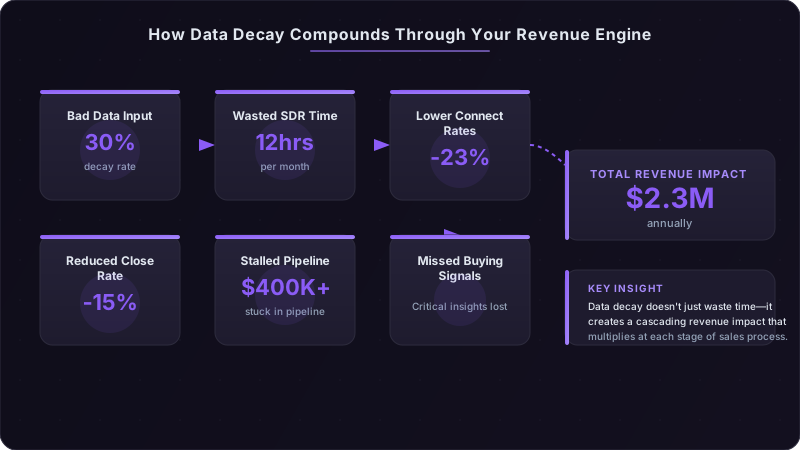
The Real Cost of Bad Sales Data: A $2.3M Problem Most Teams Ignore
Outdated contacts and wrong job titles cost B2B teams an average of $2.3M annually in lost pipeline. Here's how to calculate your own data decay rate.
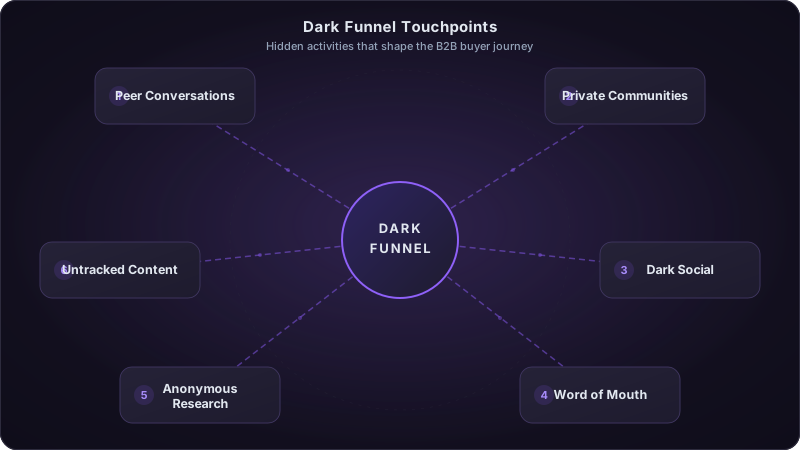
Cracking the Dark Funnel: How to Attribute Revenue When 70% of the Buyer Journey Is Invisible
Most of your pipeline is influenced by channels you can't track. Podcasts, Slack communities, word-of-mouth, and private social sharing drive deals you'll never see in your CRM. Here's how to measure the unmeasurable.
Your CRM Data Is a Liability: How Bad Data Costs You Deals
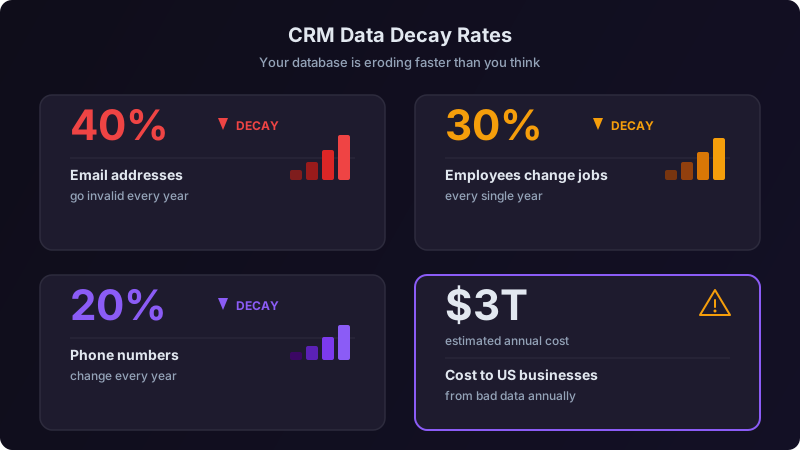
40% of CRM data decays annually. Learn how data quality issues are killing your pipeline and what to do about it.